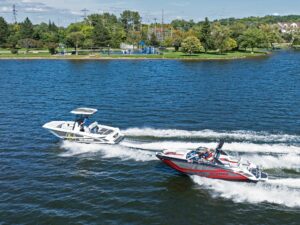
One of the sharpest-looking new midcabin cruisers is also one of the fastest: Campion’s 50-plus-mph 925 Allante is a tour de force of line and form. Take this can-do Canadian for a test drive and you’ll find exceptionally rugged construction, excellent performance, and amenities that exceed the standards of most boat manufacturers. That said, you may also conclude – as we did – that engine access is clumsy, standing at the helm is uncomfortable, and the stern cleats would prove more functional if they were positioned farther aft.
So if you’re in the market for a 30′ cruiser, should you take the 925 Allante for a ride? Without a doubt. You’ll discover that all things considered, the 925 Allante shines brighter than many boats that have starred in this particular category.
LISTENING SKILLS. Let’s talk intangibles – or at least invisibles. Sound levels underway are an important consideration when shopping for a cruiser. Too much noise is more than annoying. Once you’re underway, it hinders conversation and irritates everyone onboard.
So keep your ears open as you demo ride the 925 Allante. At 3500 rpm, our test boat, which was powered by twin 250-hp Volvo Penta 5.0 Gi DuoProp stern drives ($6,677), produced a 33.5-mph nominal cruise speed and burned 17.8 gph. Those are some good numbers. But the more remarkable figure didn’t come from our fuel-flow monitor or radar gun. It came from the sound meter. At 78 dB-A, the 925 Allante is quiet enough to let you cruise for 186 miles and enjoy the company of your guests without resorting to a bullhorn.
Credit the hushed ride to Campion’s design, construction, and assembly. The 925 Allante’s engine compartment is generously insulated. The motors themselves have cushioned mounts bolted to the Kevlar-reinforced stringers. Because the engines have been soft mounted to hard beds, only suppressed engine vibrations travel throughout the boat’s structure. This, in turn, diminishes noise, especially those annoying, rpm-specific buzzes and rattles that can drive a captain crazy. Take a look from inside the engine compartment and you’ll notice that the 925 Allante’s hull and deck are joined by through-bolts. This method of joining the hull to the deck is normally reserved for go-fasts and offshore sportfisherman because it results in rugged, long-term durability – and it minimizes noise. How? Unlike boats in which the hull and deck are joined by screws, through-bolting reduces the amount of movement between the two as the boat “works” (flexes and tenses) while underway. Creaks and groans are significantly reduced.
THE HIGHS: Runs fast and handles well. Sexy, distinctive lines. Quiet enough that you can talk without screaming while cruising. More standard equipment than its competitors.** **
THE LOWS: Forward-hinged hatch hurts access to engine compartment. Not enough room between the helm and the seat’s base to stand comfortably. Needs some additional cleats aft.
What you can’t see is perhaps the most important noise-reduction feature. The meat that is sandwiched between the layers of fiberglass from which the 925 Allante is constructed is a product called Corecell. It’s responsible for the 925 Allante’s light weight (which we’d say is the reason for its speedy top end) in comparison with Regal’s 2960 ($115,500 with twin 250-hp MerCruiser 5.0L EFI Bravo Three stern drives) or Wellcraft’s 3000 Martinique ($115,520 powered as our test boat). This closed-cell foam also attenuates noise from both machinery and the hull as it cuts through the water. None of this will quiet the yells from your crew when you put this boat through its paces. The 925 Allante is a hoot and a half to run. Click the standard Gaffrig controls forward. These precise shifters – a costly option aboard many boats – stay where you put them. The 925 Allante takes off like a rocket. Cut the wheel. We threw the helm hardover at 4500 rpm and carved right around. Wakes? If waves were wheat, the 925 Allante would be a sickle.
The reason for this performance-boat-like ride is its performance-boat hullform, which Campion calls Apex. It sports a notched transom, which reduces drag by allowing the drives to be mounted higher, as well as a hullpad that reduces the wetted surface – read: friction – when the boat’s on plane. The deep-V makes it soft riding, so you can take advantage of all those ponies stabled aft. And by converting slams into smooshes, the Apex hull’s V-shape also contributes to the quiet ride.
WHAT THE…? Meanwhile, try to check the oil, and you might end up making some noise of your own. Instead of kneeling on the cockpit sole to get inside the engine compartment, as you would aboard the 3000 Martinique or the Regal 2960, you are forced to climb onto the exhaust risers and crouch between the motors of the 925 Allante to check the sticks. Why? This boat’s electric hatch is forward hinged.
You wouldn’t want to have to get to a seacock quickly in there, especially when the motors are hot. That’s probably why engine hatches aboard most stern drive-powered boats are hinged to open aft.
Climb out, close the hatches, and you’ll notice that Campion apportioned space in the 925 Allante’s self-bailing cockpit with an emphasis on entertaining. The aft lounge features a removable section, as an open space is often more desirable on a boat than sheer seating capacity.
The wetbar is large and offers hot and cold water as well as the option for an icemaker ($1,320) or refrigerator ($920). The transom shower also runs hot and cold. We’d like to see an additional pair of cleats mounted on this transom. The standard aft cleats, installed several feet forward along the topsides, will make scissoring your lines while docked stern-to difficult.
Iffy weather? Don’t change your plans. Unlike the 3000 Martinique, the 925 Allante comes with a full camper canvas. Carpet and a foredeck sunpad are also standard equipment.
There’s room for two on the doublewide helm bench. This features a flip-up seat, but it’s uncomfortable to run the 925 Allante while you’re standing. There’s only 1’2″ between the helm and the seat’s fiberglass base. A recess in the seat base would provide enough heel room to stand properly. Helm station highlights include trim tab indicators, a fluxgate compass, and an idiot light that alerts you if the swim ladder is down.
OOOOH, YEAH. Belowdecks, the 925 Allante’s mahogany and ash decor is inviting. Above, a fiberglass headliner with several upholstered inserts adds a slick, reflective quality. The galley features a wood floor, the typical array of appliances, and a single-burner alcohol/electric stove installed in the large Corian counter. You can heat up soup away from the dock without ordering the optional genset ($10,372).
An electric commode, often an option on other boats in this class, is standard here, as is a hot and cold shower. The hard-wood floor grating, shelving, and medicine cabinet provide a home-like feel.
The midcabin and V-berth will sleep two adults each. You might want to reserve the convertible dinette for the kids. Then again, since the camper canvas is standard, hand the tykes a star chart, bed them down in the cockpit, and enjoy a good night’s sleep.
LAST WORD. Quick, quiet, responsive, and equipment-rich. Put this boat on your must-see list.
LOA …..30’0″
Beam …..10’4″
Draft …..2’6″
Displacement (lbs., approx) ……..9,100 ****
Transom deadrise …….20° ****
Bridge clearance ..10’4″ ****
Minimum cockpit depth ……….1’10” ****
Max. cabin headroom..6’6″ ****
Fuel capacity (gal.)…110 ****
Water capacity (gal.)..30 ****
Price (w/standard power) ……….$92,071 ****
Price (w/test power) ……….$98,748 ****
STANDARD POWER: Twin 205-hp Volvo Penta 4.3 Gi/SX V-6 gasoline stern drives. ****
OPTIONAL POWER: Twin MerCruiser or Volvo Penta gasoline stern drives to 640 hp total.
TEST BOAT POWER: Twin 250-hp Volvo Penta 5.0 Gi DuoProp V-8 gasoline stern drives with 305 cid, 3.74″ bore x 3.48″ stroke, swinging F5 DuoProp ss propsets through 1.95:1 reductions. ****
STANDARD EQUIPMENT (major items): Hot and cold transom shower; foredeck sunpad; electric head with holding tank; dockside water; 110v shorepower with cord; 20a battery charger; hardwood floor in galley; microwave; coffeemaker; single-burner stove; water heater; color-coded electrical system; Gaffrig controls; depthsounder; trim tabs w/indicators; 12v power outlets; remote oil filters; dual battery system; snap-in carpet; full camper canvas enclosure; Clarion AM/FM/CD stereo with 8 speakers.