Header - Ads / PCD

Crocodile Rock

The odds of finding a croc are 1,000 to 1 – sounds like a good bet to us.
By Pete Mcdonald
0%
or
0%
image-6222004171514
Crocodile Rock

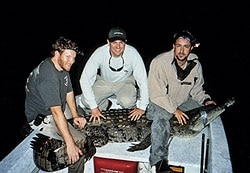
The first thing we see is its eyes, two orange embers glowing against the night. Mark Parry keeps all 200,000 candle-watts of his spotlight aimed at those fiery dots while Mike Cherkiss idles down and points our skiff toward the mangroves. We inch forward, whispering, waiting for the prehistoric creature to take shape in the light. Drifting up to the trees, we finally see its massive, shovel-like head. The full length of his muscular, leathery body is tucked under the root canopy, we can barely see it. Parry and Cherkiss step out of the boat and…wait a minute…guys…what are you doing?

I know what my buddy Dave and I are not doing-going in after them. We've come to the Everglades in search of the rare American crocodile, not to become midnight snacks. The odds of finding one on our own are against us, so we asked the two biologists to show us some tricks. Now they're in the water with one-and it has really big teeth.

Beauty of the Beast

There are roughly 1,000 crocodiles scattered along the southern tip of Florida, the only place in this country they inhabit. The best place to look for them is in the brackish waters of the crocodile sanctuary in Everglades National Park. But you can't go there unless accompanied by scientists. So now I'm wondering: If Parry and Cherkiss get eaten, do we lose our permission slips?

Parry wades toward the animal and quietly slips a noose made of twined wire over its head. Surprisingly, the croc doesn't react. He's used to being at the top of the food chain. Not much bothers him. The noose is connected to a Thompson snare: an 8'-long pole made from a tomato stake with a length of rope attached to the wire. Cherkiss cleats the rope's bitter end to the boat's bow, gets behind the croc, and taps it gently on its tail. The night-black water explodes.

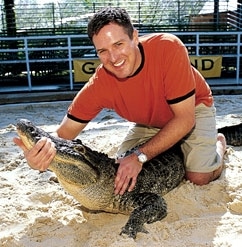
The animal most people think of when you say crocodile, is actually an alligator. There's a big difference. Crocs have a longer, narrower snout with teeth that stick out from its jaw. You can see a gator's teeth only when its mouth is open. From far away, a croc is distinguishable by its light-brown skin; an alligator sports a dark green hide. Gators live throughout the Southeast, and their habitat puts them into frequent contact with humans. They're also more aggressive, meaning they're far more likely to roam from the water in search of food-which in developed areas consists mostly of poodles. But the crocodile is an elusive creature.

Even here, in the tangles of the Everglades, we're lucky to see one at all. Parry and Cherkiss insist that, unlike its African cousins shown shredding wildebeests on Animal Planet, the American crocodile is timid and shy. Watching the melee under the mangrove roots, I'm not convinced.

Back in the boat, Cherkiss eases the engine into reverse to slowly pull the snared croc from the trees. He kills the engine, and it's the croc's turn. For the next hour, the animal pulls us all over Little Madeira Bay. "We're tiring him out so we can get him in the boat," says Cherkiss. In the boat?

Cherkiss and Parry are biologists from the University of Florida. They make their living capturing, tagging, and monitoring crocodiles. Though the animals live in brackish water, they are dependent on the freshwater flowing to Florida Bay from the Everglades. So the university's study not only indicates the vitality of this endangered species, it gauges the health of the entire ecosystem as well.

The two scientists haul the croc onto the foredeck, moving quickly to secure it. Cherkiss sits on its shoulders and tapes its mouth and eyes with duct tape. Dave and I stand warily in the stern. We've captured a teenager, a 10'-long male. Markings on its tail indicate that he's been tagged before, in 1996. "Isn't he a beautiful animal?" asks Parry. Yes, he is and, for the moment, remarkably docile. But I'm not the one who'll have to take off the tape.