Boating Writers International 11th Annual Writing Contest – Peter McDonald’s “Seamanship” won 1st place in the Boating Columns category.
We were caught in a hairy situation fraught with mayhem and angst. Were we being pounded by a squall or trying to run a dangerous inlet? No, this was worse. On a hot, busy weekend, the wind had pinned us to the fuel dock while a crowd of boats waited to take our spot.
To add to the froth, a large sailboat pulled up to our stern and a cruiser sat a foot off our bow. We couldn’t go forward or backward, and the wind kept us from going sideways. We were stuck, and the world was watching. Out of desperation, I came up with this idea.
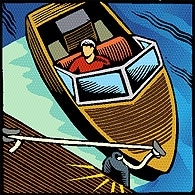
I tied the bow line to a dock cleat just forward of amidships. Then I put the engine into gear and idled forward with the wheel turned toward the dock. The line came taut, preventing us from going ahead. I gave it more power, and the stern began to swing away from the dock without coming close to the bow of the offending blowboat. Once the stern was clewed, the dockmaster untied the line, threw it to my friend on the foredeck, and I continued to back out unimpeded.
How does this work? Simple geometry. When you apply power, the dockline holds your bow in place so it becomes a fixed pivot point. The only part of the boat that can move is your stern, which swings out in an arc around the bow. The key here is to be gentle with the throttle. Apply just enough power to get the stern moving and then let momentum take over. If the stern doesn’t swing out, give a momentary touch of acceleration, then quickly ease off the throttle.
I later found out that this technique, called “warping” (from the old Dutch word for a towline), has been used by tugboats from the beginning of time, so unfortunately, I couldn’t name it after myself. I also discovered that you can use warping to swing the bow out. Tie off the stern, hit reverse, and the bow swings away from the dock. However, in a strong wind this may not always work, as the pivot point and source of power are close together and thereby reduce the leverage needed to twist the boat around.
You can also use this method when the wind is blowing off the dock and you’re trying to get in, or you want to come in side-to into a tight space. Tie a line to a midship cleat, bring the bow to the dock at an angle, and either throw the line to someone onshore or have a crewmember step onto the dock from the bow. The line gets made fast to the dock aft of the cleat to which the line is tied. Put the engine in forward and swing the wheel away from the dock. The line will prevent forward motion and the stern will swing in.
Warping can also help you pivot around a piling and back into a slip if the current or wind is against you. Bring the side of the boat up against an outer piling. Tie one end of a line to a midship cleat, loop it around the piling, take up as much slack as possible, and tie the line back to the same cleat. The boat is now attached to the piling, which becomes your pivot point. Put the engine in reverse, turn the wheel toward the piling, and the stern will swing into the slip. Simple geometry.
The next time you get stuck in a tight docking situation, remember what your line, your cleats, and a little warped thinking can do.