Nestled at the mouth of a river running to sea along the mid-Atlantic coast is a top-secret facility where Volvo Penta tests and develops new engines. I could reveal the location, but then my life may be forfeited. No kidding. Boating remains one of the few magazines to get behind the barbed wire. Security here is tighter than an El Al departure from Tel Aviv’s airport — and with good reason. Some of the best propulsion engineers, engine technicians and test drivers in the world put motors, drives and installation practices through their paces prior to retail release. With millions in development costs on the line, preventing competitors from getting a whiff is job one.
While there, I tested the just-released stern-drive joystick, new engine management systems and other things on which I’m still under a gag order. But as sometimes happens while on assignment, a new story dropped in my lap.
Volvo Penta maintains a fleet of 20-something boats at the test center. These run five days a week, in all kinds of weather, year-round. “The only times we stop are for lightning and poor visibility,” deadpanned test-center manager Bob Crocker. The boats here are used more in a week than most are used in a year. Many of the test boats are in perpetual need of structural repair as a result of this accelerated aging. But a few just keep on going. They are Crocker’s go-to boats, the toughest boats in the world.
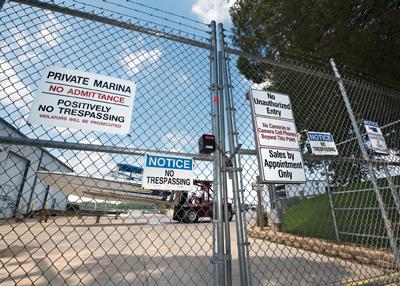
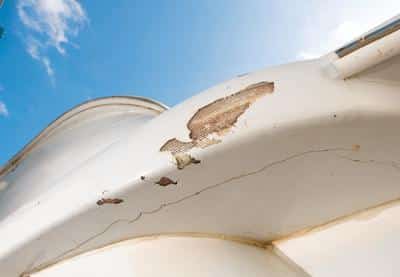
The Volvo Penta Marine Engine Test Center looks like any boatyard in America: a tiny village of sheds, barns and offices, complete with a Travelift and a fuel dock, scattered about some gravel-strewn waterfront acreage. Heading to the dock, Crocker and I cut between several boats on the hard. I stopped to comment on the glaring need one had for repair. Its hull-to-deck joint had failed, the pulled screws, shredded ’glass and drooping rub rail creating a sinister grin.
“Hull and deck separation is fairly common,” Crocker said. Not good. This connection between the two biggest “parts” of a boat is a critical structural feature you should look for when shopping. Skimp here and problems range from leaks into the cabin to catastrophic failure. How do better boats ensure this juncture’s integrity? I ask the builders of the boats that have yet to suffer that indignity, even after years of unsympathetic service in the test-center fleet.
Mac Privott, president of Carolina Classic, whose 25 model is a mainstay at the test center, says his boat’s hull and deck are through-bolted using locknuts, with 3M 5200 polyurethane adhesive/sealant in the lap. “And we apply fiberglass to high-stress areas,” Privott adds.
Rick Eggerding, director of product development at Tiara Yachts, is proud of the way his 3800 Open has held up at the test center. Eggerding also cites the use of tightly spaced fasteners in conjunction with Bostik 920 urethane adhesive for the boat’s high marks. Eggerding expounds deeper: “It’s like building a house — a good foundation and good walls are essential. Tiara’s bottoms are stiff; our decks are supported by bonded bulkheads. It creates a monocoque structure in which the stresses are spread around rather than being transferred directly to the sheer.”
Through-bolting and a chemical bond are also credited by Formula Boats’ plant manager, Pat Laux, in explanation of the robust longevity the pair of Formula Fastechs have shown at the test center. Formula uses Plexus adhesive. “It’s like welding the parts together,” says Laux, who describes a test process in which glued parts are placed in a hydraulic press in order to find the failure point. “We found that the glue had better adhesion than the resin and glass.”
Crocker’s a big fan of welded aluminum boats. “We can fix it a lot quicker than a crack in fiberglass and get the boat back in the water in an hour.” That’s nice to know, but so far this hasn’t been required for the 36 EagleCraft in the test-center fleet.
Welding is the way to connect a hull and deck. Steve Degel, builder of aluminum EagleCraft Boats, says some builders use rivets, but EagleCraft boats, like those that ply the secret waters year in and year out, are welded, resulting in a connection that’s super strong. “You could lift it out of the water by the deck without that joint coming apart. It’s a monocoque structure.” That word again.
“Most of the problems occur on time, ” insisted Crocker, meaning that something letting go all at once is a rare occurrence. For example, Volvo Penta’s test regimen involves diagnostic checks that might include the driver opening the engine hatch 20 times a day. Some don’t last a week, the equivalent of perhaps three years in recreational service. Others stand up fine. Hmm.
“We use full-width piano hinges instead of point-loading a strap hinge,” says Privott of Carolina Classic. “We use hydraulic lifts by Oildyne, not the cheapest pump by any means but very, very, very reliable.”
Tiara also uses pricey, top-quality parts and submits every component to rigorous testing before approval. Consider details like the way it synches its dual ram lifts so there’s no twisting of the hatch. Tiara installs hinges with through-bolts and backing pads. Just like a cleat.
At Formula, it’s more of the same: high-quality components installed in a more labor-intensive fashion. “We use so few lag screws, I wouldn’t know where to look for them in the plant,” Laux quips.
EagleCraft’s Degel has quality control locked with respect to engine-box hatches. The company fabricates its own hinges. One look at the hefty arms the hatch covers ride on is enough to tell me they’re made for the long haul.
You probably don’t run your boat wide open, regardless of sea conditions, for hours on end, as a Volvo Penta test driver does — and probably wouldn’t like it if you did, since Crocker said he has to pull the pros out of the rotation periodically due to the mental and physical stress. But remember that he also explained how most things don’t come loose and break all of a sudden. So don’t expect a lowquality boat to show its true colors right after delivery. The test boat’s week is equal to your season. It’s a proving ground for long-term durability. These boats just reach long-term sooner than those in recreational service. One result is that accessories break loose aboard some of the boats in his fleet, Crocker said. But it doesn’t happen aboard all of them.
“We don’t screw accessories in unless we have to,” says Carolina Classic’s Privott. “We use bolts. If we have to screw, we use enough fasteners and apply ’glass tabs strong enough to hold the accessory.”
Tiara’s Eggerding says, “After 35 years of testing, of trying to find ways to make them break loose, once we find a system that works, we stick with it.”
Bolts and beef — I smell a trend, one that Formula’s Laux corroborates: “Lots of builders build cabinets with pine cleats and staples. We use 90-degree aluminum brackets, through-bolted with nylock nuts. We attach them to stainless hull brackets, bolt them to the bulkheads and Plexus-glue the bases to the stringers.” Moo.
Building in aluminum, Degel’s solution for keeping accessories put is identical in philosophy, though it’s different in execution. His boats are plated with heavy-gauge 5086 alloy plating supported by welded-in-place stringers. They don’t flex. That’s the good-foundation thing we kept hearing. This allows EagleCraft to secure accessories by drilling and tapping threads into item-specific, custom-welded brackets — or even the structure of the boat itself.
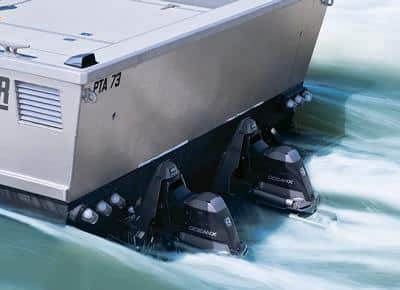
You’d think, since the boats in Crocker’s charge are run daily, stored in the water and hauled frequently so teams of wrench-turning technicians can install new engines and drives, that they’d appear a bit beaten up. Some of them were, displaying the heavy gelcoat chalking and stress cracking that results from weather and wear.But the cream of the crop looked fine. Oh, they looked used. But the cosmetics of the toughest boats would earn them at least “good” condition by any surveyor I know. With a little detailing, they’d be the pride of any boat owner who had put five years under the keel. And when I question the builders, they reiterate the same basic message, summed up succinctly by Privott of Carolina Classic: “In a nutshell, if you’re going to beat a boat to death, you have to build it so it can take it. When the whole boat gets ’glassed together, it all tends to move together rather than flexing and pulling itself apart.”
To the point, Privott explains that cracking results when the ’glass under the gel flexes. That’s why he builds his boats stiff enough so they don’t flex. More-serious gel peeling can be prevented by adhering to a strict bonding schedule.
Tiara’s Eggerding reiterates Privott’s statement, claiming a stiff overall structure prevents the flexing that causes cracking, and crediting the use of higher-quality gelcoat applied to just the right thickness (20 to 22 mils) by an experienced applicator.
“You have to engineer your skin coat,” maintains Formula’s Pat Laux, referring to the layer of chopped ’glass backing the gelcoat, “to be compatible with your gelcoat.” Both need to have the same flexural properties, he says, citing Formula’s process of “filamentizing” the chopped strand with a special roller called a bubble buster. “This must be done by experienced hands or you’ll be left with puddles of resin that are brittle. We don’t pay anywhere near minimum wage.”
As to fading and chalking, Formula boats are painted with Imron over the gelcoat. Paint better resists the ravages of sun and water and is easier to maintain, requiring no waxing. A simple wash and rinse keep the finish lustrous.
EagleCraft boats don’t have stress-cracking problems, being aluminum. These boats can be ordered unpainted, like those at the Volvo Penta facility, and will maintain a dull luster thanks to the self-protecting properties of oxidized aluminum. Others are painted, and with the same advantages listed for the Imron-coated Formula boats: deep gloss, high shine and easier maintenance compared with gelcoat.
So there you have it. If beef, bolting and chemical bonding — or welding — stand up to the rigors of life at Volvo Penta’s engine test center, they should serve you in fine style.
What to Look For:
Weak Points
Why do certain boats hold up to the rigors of the Volvo Penta Marine Engine Test Center? We were able to zoom in on several factors — the same ones you can look for when assessing a boat’s build quality.
[1] Hull-to-Deck Joint: Covered by the rub rail, this is where the two major components connect. You can see the joint from within anchor lockers, engine rooms, battery compartments — anywhere the interior of the hull side is accessible. The best joints are “bonded” with either fiberglass or adhesive (not just caulk) and bolted. Understand that the time spent doing the job better, say ‘glassing versus riveting, is an enormous part of the cost difference between the methods.
[2] Good Support: A good foundation makes the boat stiff, reducing everything from cracking gelcoat to sound transmission. Stringers are the lengthwise structural members; bulkheads run across the beam. Nowadays, many are integral “grids” or “grillage systems” combining both in one large part. Either way, look for bulkheads that are full height to the underside of the cockpit sole. Stringers should be the same height for their entire length, and taller is better. These should either be ‘glassed in place and the “tabbing” rounded (not made at a right angle) or glued in with one of the new superadhesives.
[3] Bolt-ons: Boats are chock full of necessities and luxuries that need to be fastened in place. Whether it’s a water heater or a battery charger, a cleat or a hatch hinge, check to see that it’s secured by through-bolts and locknuts and backed by a metal plate or relatively incompressible coring, such as plywood or composite board, to distribute the load. Full-length piano hinges are superior to strap hinges. When a wake rocks your anchorage, that towel rack in the head suddenly transforms into a grab rail. When your friend leans too hard on the open transom fish-box lid, he could go splash. Do you want to trust your keister to screws or bolts? Don’t be nuts — demand them.
_**Want to know which boats are the toughest? Check out the April issue of Boating to see which ones spend more time on the water than in the repair shop. And if you have some tough boat recommendations let us know in the forums.
**_