Boating Writers International 11th Annual Writing Contest – Daniel W. Long’s “30 Ways to Sink A Boat” won 1st place in the Boat/Engine Care Maintenance Category.
Remember the time you were running through the bay and heard a thump from below? Wasn’t that fun? No? Did it stir up that dreaded boating moment-the fear of sinking? No one likes to imagine such a thing happening. Yet every year thousands of us unwittingly experience that shiver of fright-and hundreds of us take it a step further by actually sinking.
• Billions of dollars worth of fiberglass sits on the ocean floor, mostly because it’s so easy to stop a boat from floating. You don’t even have to meet and greet a rock to get a one-way ticket down. In fact, you don’t have to do anything. Just let your boat sit awhile, and eventually it will find the bottom. According to BoatUS, the largest insurer of pleasureboats in the country, for every boat that sinks at sea, four go down in their slips.
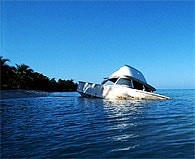
30 Ways To Sink a Boat
• To find out why, we asked around the docks, checked insurance records, and talked to boatyard owners. Here are the top 30 preventable disasters. Not interested? Okay. But know that the cost of repairing a boat that’s done an underwater disappearing act is usually 40 percent of its total value. Now that we have your wallet’s attention, read on.
1. Stern Drive Bellows
What Happened: The rubber dried and cracked. Water seeped past the gimbal bearing and poured into the boat because the bottom of the gearcase cutout was well below the waterline.
What You Should Have Done: Store your stern drive in the down position when out of the water to avoid the bends and creases that stress rubber. Inspect the bellows two or three times a year and replace it annually.
2. Scuppers in the Fall
What Happened: The scuppers got clogged with leaves. Although this won’t seal the drains, it can greatly slow the release of water. In a heavy rain the cockpit can fill enough to weigh down the boat so it floods or accumulates enough water to reach non-waterproof openings in the deck and fill the bilge.
What You Should Have Done: Keep the cockpit covered, or have wide-mesh external screens made to protect the scuppers.
3. Scuppers in the Winter
What Happened: White stuff fell and ice built up around the scuppers, filling them in. Since this occurs under the snow, you can’t see it. The good news is that once the boat sinks, the ice will melt.
What You Should Have Done: Haul out for the winter, or have a waterproof, reinforced cover that can take the weight of accumulated snow. Don’t treat your boat like your mother-in-law: Visit it often.
4. Scuppers Anytime
What Happened: A piece of plumbing corroded, cracked, or just gave up. The weakest link is the hose that can crack, most often around the stress points created by the clamps.
What You Should Have Done: While the boat is on land, check the hoses by flexing them back and forth. If there are any cracks, replace the hoses.
5. Hose Clamp Failed
What Happened: A hose attached to a seacock below the waterline, or a through-hull just above it, came off its fitting because the hose clamps gave way.
What You Should Have Done: Secure each hose with two clamps where it passes over the fitting’s nipple. Check that the clamps are all stainless steel (a magnet won’t attract stainless). Often, the tightening gear and its case are mild steel, which rusts away.
6. Trapped Under a Dock
What Happened: You tied up the boat at low tide. The wind pushed part of the boat under the dock, the tide came up, and the boat became trapped beneath the dock, then sank.
What You Should Have Done: This can happen when the pilings supporting the dock are too far apart to keep the boat parallel to the dock and out from under it. No matter how many docklines you rig, this will be a problem. If you can’t dock somewhere else, set anchors out from the bow and stern so the boat won’t swing.
7. Tied Down, Tide Up
What Happened: At low tide, your bow and stern lines were tight. When the tide came up, the lines stayed that way-firmly holding the boat down as the water rose.
What You Should Have Done: Long spring lines attached at acute angles to the boat adjust as the boat rises and falls. Bow and stern lines may have to be tended as the tide goes through its cycle.
8. Stuffing Box
What Happened: The packing gland surrounding the propshaft loosened. Or perhaps it rotted away as it hadn’t been replaced for many seasons.
What You Should Have Done: Dripless shaft seals that require minimal maintenance are used by 90 percent of today’s boatbuilders. But many boaters still use old-fashioned stuffing boxes on the rudder shafts. Check stuffing boxes often, and beware.
9. Damage From Dock
What Happened: The wind started to blow, pounding the boat against the dock until a hole appeared.
What You Should Have Done: Tie up on the downwind side of the dock so the wind holds you away from the structure. Fenders would help. Use the round-ball type when up against a flat surface such as a concrete seawall. Use fender boards, a heavy board suspended between two fenders, when you’re against pilings.
10. Dockside Water Pressure
What Happened: An internal freshwater hose burst from the pressure of dockside municipal water.
What You Should Have Done: Shut off the water at the dock when you leave the boat.
11. Freshwater Flooding
What Happened: A fitting fails in the freshwater system. Thinking a tap has been opened, the pump senses a reduction in hose pressure and turns on the supply water-bad news if you’re hooked up to dockside water, which will keep pumping into the bilge.
What You Should Have Done: Never leave the boat without shutting off the water at the dock. This way, if a fitting or hose fails, you’ll pump only the water in your tank into the bilge. Better yet, disconnect the hose from your boat. Any moron walking down the dock could turn on the hose if it’s connected.
12. Generator Cooling Intake
What Happened: The hose cracked, water flooded, boat sank. I hope you’re picking up a pattern here about hoses.
What You Should Have Done: Use series 135 heavy-duty water hose-no exceptions. It resists chafe, is reinforced to prevent collapsing, and has a working pressure of up to 200 psi. Wiggle the hose where it meets fittings to look for cracks. Rub a damp cloth along it. If there are black marks on the rag, the hose is deteriorating.
13. Head Intake
What Happened: An unprotected head-intake hose running through the engine room bulkhead chafed, then failed.
What You Should Have Done: Do your hoses make as few bends and turns as possible? They should be secured tightly and padded where appropriate.
14. Head Intake II
What Happened: The water-fill hose connecting the outside of the hull to the head crapped out. The head, being below the waterline, filled and so did the boat.
What You Should Have Done: Besides maintaining the hoses and clamps, make sure the boatbuilder has left easy access to the inlet’s seacock. Make it a policy that when you leave the boat, you shut all the seacocks. Then, if a hose fails, it’s no big deal.
15. Head Discharge
What Happened: The one-way joker valve on the head’s discharge got something in it. You were smart enough to run the discharge hose above the waterline to keep water out but not smart enough to remember how a siphon works. Trying to siphon the full contents of the Atlantic Ocean, your boat soon sinks.
What You Should Have Done: To prevent a reverse flow, when you run any hose above the waterline, remember to install a vented loop fitting at the top of the loop. This lets air in to prevent a siphon. Use fittings that let you disassemble the valve each season to make sure it’s clear and working.
16. Check-Valve Backflow
What Happened: Since the through-hull is mounted so low to the waterline, a clever mechanic put a one-way check valve on your bilge pump’s exhaust hose to keep the sea out. Too bad it didn’t.
What You Should Have Done: Check valves are unreliable and can get stuck open. Route the pump’s exhaust hose as high as possible to a through-hull near the rubrail. If it must go to a low outlet, run the hose up inside the boat as high as possible, install an anti-siphon valve at the top of the loop, and run it to a seacock that you can close.
17. Ice in Sea Strainer
What Happened: When it was time to winterize, you put antifreeze everywhere except in the strainer at the raw-water intake. Then you left the boat with the seacocks open. The water in the strainer froze, expanded, and cracked the strainer. Water came in and the boat went down.
What You Should Have Done: Close the seacock and open the strainer’s drain plug to empty it of water. Then fill the hose and strainer with anti-freeze, because you never get all the water out and it’s better to be safe.
18. Plastic Through-Hulls I
What Happened: The cheap ones that came with the boat got brittle from ultraviolet light and gave way from the weight of the hose. Or maybe the hose barb cracked when you overtightened the hose clamps.
What You Should Have Done: We prefer stainless-steel or bronze fittings below the waterline.
19. Plastic Through-Hulls II
What Happened: The mechanic was in the bilge repairing the engine. While trying to get better leverage to force a rusted bolt free, he wedged his foot against a through-hull. He pushed and it cracked.
What You Should Have Done: Stick with stainless steel or bronze below the waterline. And use a better mechanic.
20. Transom-Mount Transducers
What Happened: You were smart to use bolts instead of screws to mount the transducer to the transom. But over the years the transducer has gotten nudged, hit, and smacked so often that the bedding compound loosened and enlarged the boltholes enough for water to seep in.
What You Should Have Done: Caulking and bedding compounds don’t last forever. Check every year and rebed every four years.
21. Through-Hull Transducers
What Happened: When hauling, the straps from the sling put pressure on the transducer, which disturbed the bedding and widened the hole.
What You Should Have Done: Properly installed transducers have large backing plates to distribute the stress of an impact. This one didn’t. Or you can mount the transducer within the hull so there are no exposed parts.
22. Corrosion
What Happened: Over the years, the dissimilar metals below the waterline have been eating each other-giving them an internal structure that’s similar to Swiss cheese. Eventually, a slight nudge caused one to fail.
What You Should Have Done: Again, we prefer that stainless steel or bronze be used below the waterline. But no matter what, all metals must be protected. If your bronze seacock is turning pink, it’s falling apart. All underwater fittings should be bonded to each other with a number 10-gauge green wire, and sacrificial zincs should be used. Check annually.
23. Speedometer Plug
What Happened: Good move pulling the Pitot tube for a cleaning. Too bad you forgot to plug the hole.
What You Should Have Done: Vitamin E supposedly helps the memory. Even with a plug, you can get a leak. Rubber O-rings can deform or come loose from their tracks. Put some grease on the rings to ensure long life and a good seal.
24. Stern Drive Mounting Bolt
What Happened: The holes on the engine-mounting bracket below the waterline leaked due to weeping. The stainless-steel bolts inside the transom corroded due to sitting in stagnant water. This is called crevice corrosion.
What You Should Have Done: Check the drive bolts often. Double-check the seal.
25. Hose Slips Off Seacock Nipple
What Happened: After a day of wave bashing, the shakes and vibrations worked a hose off an open seacock.
What You Should Have Done: If there’s room to put two hose clamps on each fitting, do it. Have the excess ring material exit in a different direction on each.
26. Rubrails
What Happened: From too many bangs against pilings, the screws, bolts, rivets, or adhesive that holds the rubrail in place has come loose. Plow into too many head seas or sit through a rainstorm and water will get below.
What You Should Have Done: At the end of each season, walk around the boat blasting the hull-to-deck joint with a hose. Have someone inside to watch for leaks.
27. Muffler Rot
What Happened: Water sat in a low point and rotted the muffler. Waves at the dock came in the transom exhaust ports and went directly into the boat.
What You Should Have Done: Feel under the mufflers or risers for moisture. They will ooze dampness months before giving way.
28. Frozen Muffler
What Happened: The drain plug on the bottom of the muffler or riser was removed but not replaced. Or you didn’t drain them and the ice did its worst.
What You Should Have Done: Drain the water, but don’t unscrew the plug and then go for drinks while it drains. You’ll forget to put it back in.
29. Drain Plug
What Happened: You forgot to put in the transom drain plug when launching. Join the club. You’re an idiot like the rest of us.
What You Should Have Done: Don’t be an idiot-install a high-water alarm.
30. Hit By Another Boat
What Happened: The guy in the slip next to you hit your bow while tying to a dock. This forced the bolted-on swim platform on your boat to bang the bulkhead and loosen the bolts, which started to weep enough so that by the next morning all you saw was the VHF radio antenna.
What You Should Have Done: Do a Jackie Chan on the clown who smacked your boat. Then string him up by his nose hairs. There are some sinkings that just can’t be prevented.