Water skiing got its start in the summer of 1922, when Ralph Samuelson rode two wooden skis on Lake Pepin in Minnesota. The world’s first water skier received a tow from a low-powered inboard boat, but he also experimented with speeds of up to 80 mph behind a World War I Curtis Flying Boat during the summer of 1925. For much of the next few decades, people towed with whatever boat they had.
Then, in the fall of 1959, Leo Bentz, a Miami Beach water-ski-school operator, changed the game with a boat he built and named Ski Nautique. Manufactured in fiberglass, the Ski Nautique boasted direct-drive inboard power. Tracking, wake characteristics, power and top speed took center stage.
Because water skiing has mutated into so many different tow sports, from boarding to skating to surfing, the wake designed by Bentz doesn’t fit all needs. Today, each sport has its own preferred wake size and shape, and boatbuilders have devised a host of ways to respond. It all starts with the power, and how it’s delivered.
Direct-Drive Inboards
Installed amidships, direct-drive inboards provide the quick planing, minimal wake and precision tracking required by tournament skiers.
For competition-minded slalom skiers who want the best tow, the direct-drive inboard remains the pre-eminent boat. Why? The amidships placement of the engine provides excellent balance for the boat’s tracking and steering. It helps the hull to plane quickly for easy starts. The engine’s location, along with a relatively flat hull, creates the small wakes desired by water-skiers. The goal is to keep the wake narrow and the tracking straight. Competition skiers can tell if the boat is off course by as little as three inches.
While today’s ski boat is bigger and wider than the 17-foot-9-inch-long Ski Nautique of 1959, hard-core ski boats are the smallest tow sport boats — at about 20 feet in length — within the market segment. Innovation continues in ski boats, like the new closed-bow Carbon Pro by Centurion featuring carbon fiber reinforcement for more hull strength but less weight, contributing to a small wake.
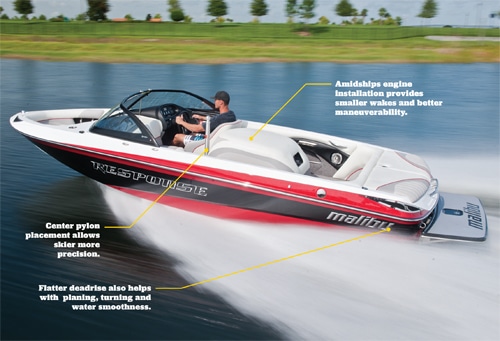
The most passionate skiers stick with a closed bow, but manufacturers do offer open-bow tournament boats, like Nautique’s Ski Nautique 200. Ditto for the Malibu Response LXi, the MasterCraft PS 197 and the Tigé 20i. Families who want high-quality tow characteristics with more interior space should sea-trial the Tigé 22i.
To adjust the wake on its boats, Tigé uses its TAPS system, an electronically controlled trim plate located at the base of the transom near the hull. Changing the attitude of the trim plate adjusts the wake from small to big, giving everyone a choice of wake shape and size.
Let’s not forget barefooters. Like the water-skier, the barefooter wants a small wake, but the wake table needs to be flat and less turbulent to make wake crossings and starts inside the wake easy. To please barefooters, the Sanger DXII direct drive features plenty of hull deadrise. Deadrise causes the hull and propeller to run deeper, making the water smoother and less turbulent inside the wake.

V-Drive
V-drive engines are installed aft, and backwards, turning the shaft through V-shaped gears and weighting the stern for bigger wakes.
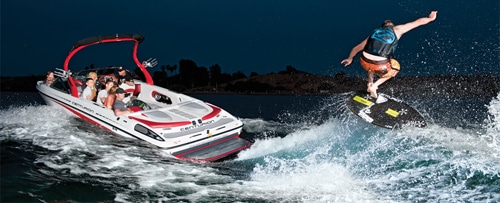
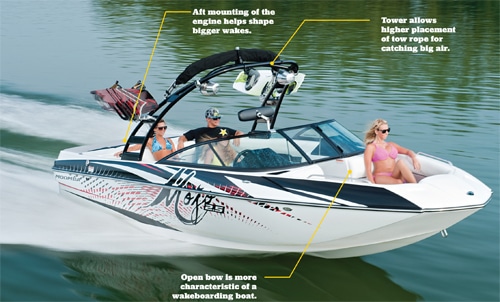
In the early 1990s ski-boat builders turned to another power option, the V-drive, with its engine mounted at the stern. Why? The V-drive opens up the cockpit for increased space, passenger movement, seating and stowage. More significant, wakeboarders understood that weight added to the stern creates a bigger wake than a direct drive could possibly make, turning the V-drive into the quintessential wakeboard boat.
Boats like the 21½-foot Malibu Wakesetter VLX target wakeboarders: They produce a big wake while still maintaining maneuverability, especially in turns. An open cockpit allows more passengers to watch the action behind the boat. Also check out the new Moomba Mojo.
The Super Air Nautique 210 provides a perfect platform for wakeboarding — and for wakeskating — with ballast in the bow and the stern. Nautique uses its Hydro-Gate, a solid plate that slides up or down the transom to alter wake shape. This allows wakeskaters to find the wake size and shape that they desire.
Surfing the boat’s wake first happened in the late 1950s at Cypress Gardens. But wakesurfing transformed into a competitive sport only in the past decade. Boat design has changed because of it. Because riders want big wakes, tow-boat manufacturers now design longer 22-, 23- and even 24-foot models. With more total weight, these tow boats ride deeper in the water and create big wakes. For example, the 24-foot Supra Launch 242 weighs 4,450 pounds without ballast.
The 23-foot-long Centurion Enzo SV 230 features more deadrise than most models in this segment, making a big wake even without filling the ballast.
Also check out the 24-foot Malibu LSV. In addition to the considerable weight of the boat and ballast, Malibu boosts wake size through its optional Wedge. The Wedge is a hydrofoil that drops below the hull to pull it deeper in the water, increasing and shaping the wake.

Crossovers: Direct- & V-Drives
Dual-purpose models for the water-sports enthusiasts who do it all
Not everyone is a competition-level skier or boarder, and not everyone needs a boat that will optimize their skill levels for a specific sport. The tow-boat builders have got this subsegment covered too. With more tow-sport features and designs blurring the lines between each category, and with families wanting to do a variety of things behind the boat, the crossover tow boat is becoming popular. The crossover is either a direct-drive or V-drive model that shares wake and tow characteristics with the other style.
The Sport Nautique 200 is a 20-foot V-drive based on the classic Ski Nautique hull. It comes, as expected, with a tower and 736 pounds of ballast capacity for big wakes and plenty of air time for wakeboarders. If you drain the ballast, this tow boat provides small wakes and excellent tracking for the slalom course. The Sport Nautique 200 includes a removable center-mounted tow pylon to give slalom skiers more exact, tournamentlike conditions. The 200 also features a Hydro-Gate for shaping the wake to surfers, skaters and boarders.
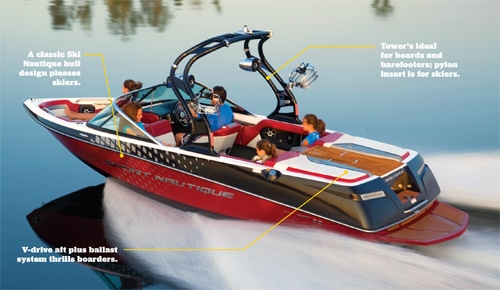
The MasterCraft X2 is another 20-foot V-drive crossover that is suited to slaloming (without ballast). Add ballast and attach your line to its tower, and the X2 turns into a wakeboard towing machine. The boat features MasterCraft’s Surf Tabs, which are electronically actuated trim tabs that are controlled from the helm to allow for fine-tuning a surf wake to the rider’s preferences.
V-drives are not the only crossovers; builders make direct drives suited for boarding, surfing and skating too. Moomba features a 20½-foot direct-drive inboard, the Outback. With a shallow hull deadrise and a weight of only 2,750 pounds, the Outback creates small wakes for slalomers while the center placement of the engine enhances tracking. Add 275 pounds to the ballast below the stern seat and adjust the trim plate mounted on the base of the transom, and the Outback rides deeper in the water for some glorious wakes.

Sterndrive Power
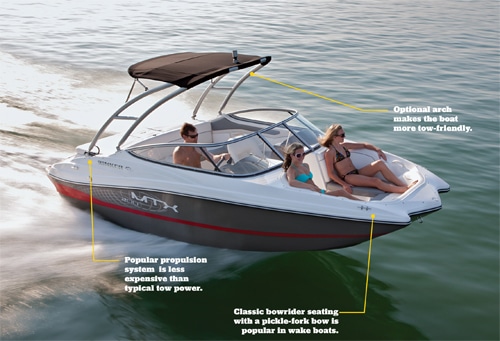
Sterndrives provide a more affordable, mainstream power option for the family looking for a more versatile boat beyond water sports.
Although the sterndrive today does not have an established image as a serious tow-sports machine, there was a time when sterndrive boats were used in water-ski competition. They offered excellent tracking, decent top speed and the favored small wake. In 1979, a MerCruiser-powered Hydrodyne towed both the men’s and women’s world jump record setters.
These days, many production runabout builders offer a sterndrive tow-sports package that includes a wakeboard tower. However, some builders add more features, turning family cruising boats into tow-sport boats. Sterndrives provide a great ride and plenty of storage — often including a changing room — while bringing hard-core features from water skiing and wakeboarding, like speed control and the high pull of a tower.
With its engine in the back like the V-drive inboard, the sterndrive is a natural for board towing. Plenty of deadrise in the hull of these boats boosts wake height. Plus you can adjust the wake shape with trim. Go all the way down for barefooting; trim up a bit for skiing and a little higher for wakeboarding, to kick up a bigger wake.
The Regal 2100 comes with an electronically controlled folding tower and GPS speed control. Steep transom deadrise adds to wake height and shape for fun in boarding. A high tow from the tower plus a flat wake work well for barefooting.
Likewise, the 2012 Rinker 200 MTX features a tower and GPS-based StarGazer PerfectPass speed control as options.
Chaparral is aggressive with its Xtreme tow-sport series that includes four hull lengths ranging from 20½ to 26¼ feet.
For dead-accurate tow speed, the Xtreme series features GPS-based speed control with the MerCruiser SmartCraft system or the Zero Off for Volvo Penta sterndrives. The 204 Xtreme features two 11-gallon ballast tanks mounted under the deck in the bow that fill and drain electronically. Add the weight of the engine in the back, and the boat sits deep in the water for a big wake for riders.