Never rest on your laurels. The truck market constantly changes, and manufacturers must keep up or else get trampled by the stampede of new products. That’s why Mitsubishi needed to give its Montero Sport a major vitality injection for the 2000 model year. A larger V-6 engine brings 200 horsepower to the party. The rear suspension was upgraded from semi-elliptic leaf springs to acoil design for a better ride and handling. A limited-slip differential for the rear axle gets better traction on slippery surfaces. And four-wheel disc brakes with ABS are now standard on 4WD models.
Both ends of the exterior have been freshened up, too. The interior of the Mitsubishi Montero Sport boasts more power outlets and cupholders. There’s even a new engine immobilizer system built into the ignition key to thwart theft. With leather upholstery and a factory-installed hitch, the window sticker creeps past $33,000.
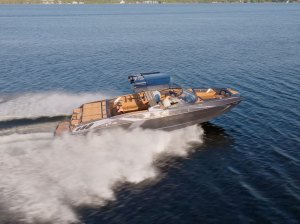
To make sure all these bells and whistles tooted properly, we tested the new Montero Sport Limited Edition, powered by a 3.5-liter SOHC V-6. To give this luxurious hauler proper exercise, we hooked up a 20-foot Godfrey Hurricane deck boat riding on a TeeNee tandem-axle trailer.
The Mitsubishi Montero Sport boasts a 5,000-pound tow rating – a lot for a compact SUV. Add a Class III receiver and your trailer will have brakes. The tow rating, however, drops to 1,500 pounds without the extra equipment. Our boat and trailer load weighed 4,720 pounds, exceeding the weight of the truck alone by 300 pounds.
The V-6 worked quietly and never strained as it hauled nearly five tons of load. Acceleration was brisk. The electronically controlled automatic transmission has what Mitsubishi calls “optimum shift control” programming. Though it worked fine under normal driving conditions, we experienced mushy shifts during heavy-throttle operation with our boat and trailer attached. It’s not particularly annoying but protracted gear changes can cause durability problems.
Launch ramp performance was impressive. We never bothered with low gears or 4WD mode (a part-time, pull-a-lever arrangement here). The largish Bridgestone Dueler tires took a firm bite, and plenty of low-end torque was available. As we spun the wheels on a wet path, the limited-slip rear axle kicked in and kept the rig rolling. We wouldn’t hesitate to use all of this truck’s 5,000-pound tow rating. Mileage was an impressive 11 mpg.
We have two gripes. The Mitsubishi Montero Sport’s high floor will force most of us to duck our heads when entering. Although the new rear suspension is a definite improvement, this truck’s ride jitters over rough pavement.
| MODEL | Mitsubishi Montero Sport Limited |
| Engine | 3.5-liter SOHC V-6 |
| Net hp/rpm | 200/5000 |
| Net torque (ft?lb/rpm) | 228/3500 |
| Transmission | 4-speed automatic |
| Front suspension | control arms, torsion bars |
| Rear suspension | rigid axle, coil springs |
| Wheelbase (in.) | 107.3 |
| Length (in.) | 181.1 |
| Width (in.) | 69.9 |
| Height (in.) | 68.3 |
| Brakes (front/rear) | vented disc/ disc; standard 4-wheel ABS |
| Tires | Bridgestone Dueler, H/T, P225/70SR-16, all-terrain |
| Curb weight (lbs.) | 4,420 |
| Towing capacity (lbs. max.) | 5,000 |
| Cargo capacity (min.-max. cu. ft.) | 43-79 |
| Fuel capacity (gal.) | 19.5 |
| Estimated city/highway towing fuel economy (mpg. avg.) | 11 |
| Price (as tested) | $33,299 |
LAST WORD. Expensive? Yes. But the compact Montero Sport Limited can tow medium loads with surprising ease.